


In the span of 8 days, we were banned from X, Reddit and Threads. 12 Days later we were banned from Linkedin. All of these accounts are around one year old or older. Each platform has employed different methods of deception, misdirection and outright lying. We do not know with certainty why this happened. In this article, we will walk through the specific methods each platform used, the implications for users like us, the broader systemic picture, and how social media is actively shaping and constraining the way we think and behave. This is a long article thus a contents menu is available below.
How Threads Banned Us
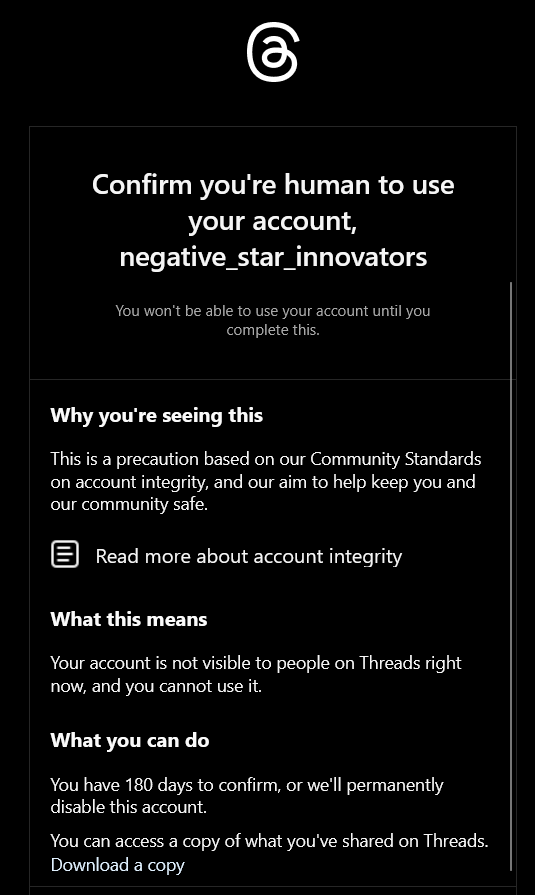
Our account was first locked and we were shown this notification [1]: "Confirm you're human to use your account. You won't be able to use your account until you complete this. This is a precaution based on our Community Standards on account integrity, and our aim to help keep you and our community safe."
The wording seemed routine. A standard identity check to confirm our humanity and access would be restored and they even guaranteed it by stating "Confirm you're human to use your account" Simple enough. Except it was not.
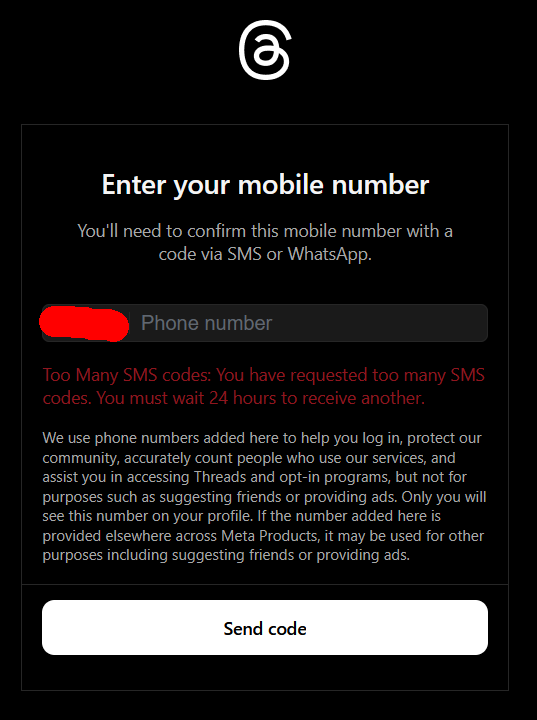
The process required SMS verification. Our first attempts produced nothing, the codes never arrived. After several attempts, we received this [2]: "Too Many SMS Codes. You have requested too many SMS codes. You must wait 24 hours to receive another." What Threads does not make clear is that the 24-hour timer resets from your last attempt, not your first. So when we tried again the following day, the timer had not expired. Thus we had to wait another 24 hours. So we waited 26 hours from our last attempt. Still the same message, even their 24 hour timer was not operating correctly. We eventually waited over 40 hours from our last attempt. This time we finally received a code.
We were then asked to submit a selfie. Since the stated purpose was simply to confirm we were human and it was only a "precaution", we provided one.
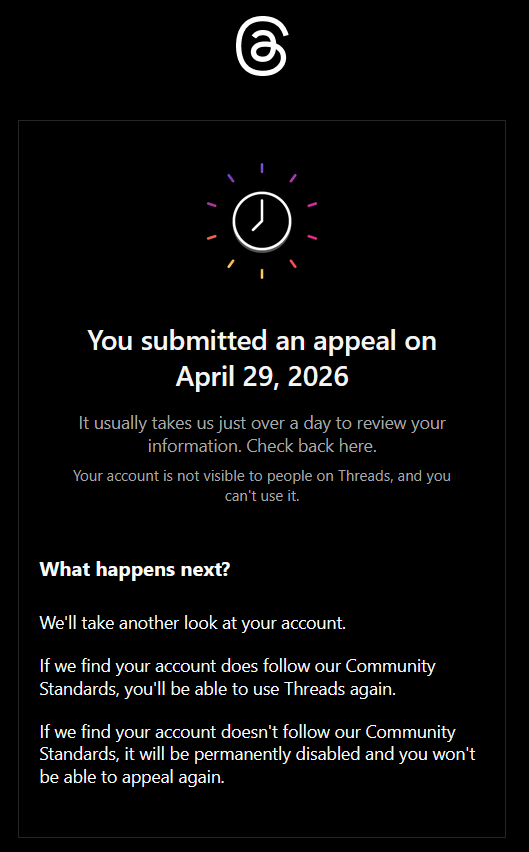
We then received this [3]: "You submitted an appeal on [date]. It usually takes us just over a day to review your information. Check back here. If we find your account doesn't follow our Community Standards, it will be permanently disabled and you won't be able to appeal again."
This was a significant shift in tone. The first notification stated they needed to verify we were human just as a precaution. This notification stated they were evaluating whether we had violated their Community Standards and informed us that the selfie we had just submitted was our formal appeal. No supporting evidence was requested from us. No statement, no context, no opportunity to explain anything. Our photo was the appeal. We were not told we were appealing anything when we submitted it.
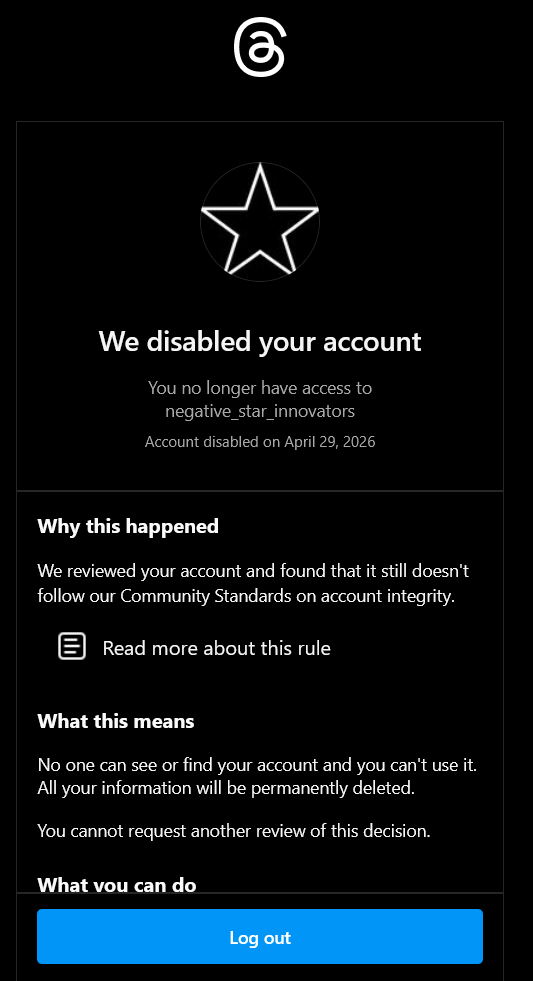
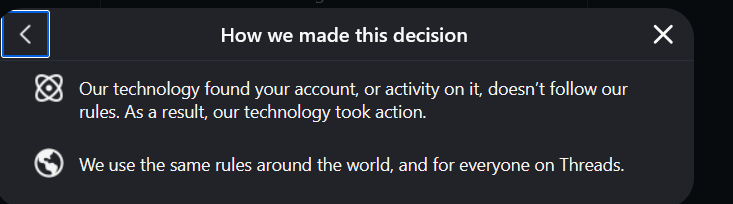
The following day we received this [4]: "We disabled your account. We reviewed your account and found it still doesn't follow our Community Standards on account integrity. No one can see or find your account and you can't use it. All your information will be permanently deleted. You cannot request another review of this decision." We were additionally informed that this decision had been made automatically [5].
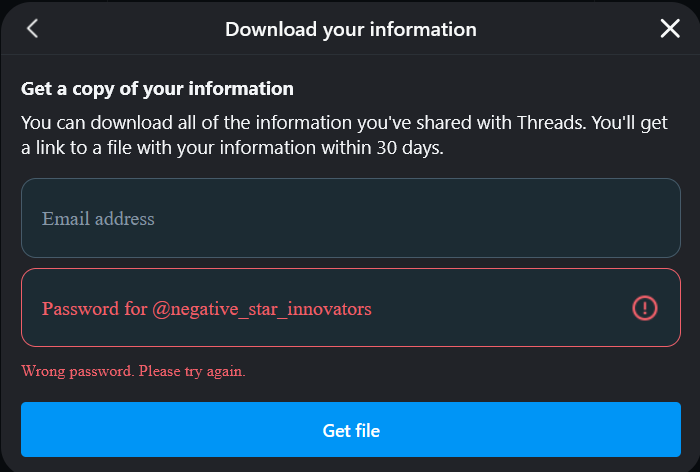
We then attempted to download our personal data. We used the exact same password we had used moments earlier to log in and view the ban notice. The system stated the password was incorrect [6]. That same password continued to work to log us in and display the notification but does not work to initiate a data download. We cannot determine with certainty whether this is a technical error or a deliberate obstruction of our right to access our own data.
Despite the explicit statement that no review was possible, we submitted a report via "Report a Problem" while signed out, and again through Instagram (Threads requires an Instagram account) while signed in, requesting both reinstatement and access to our personal data. We received no response to either. We note, however, that acknowledging our request to fix Thread's data download request would also require Threads acknowledging receipt of our appeals which Threads has chosen not to do.
The photo was not actually required to make the decision
If the decision to permanently ban our account was automated as Threads stated then why request a selfie at all? A selfie proves we are human. That is what they asked us to prove. If the selfie submission encountered a technical problem, they could have requested a second attempt, offered an alternative verification method, or asked for a government-issued ID. None of those things happened. This strongly suggests the issue was never about verifying our humanity.
The pattern instead resembles what is commonly described as a honeypot: offer the user a plausible path to reinstatement, obtain their biometric data under that framing, and then proceed with the permanent ban regardless. The logic is straightforward. The ban decision was automated, Threads said so explicitly. Since we are demonstrably human, and the photo confirmed it, the decision to ban us had to have been based entirely on our account data. That same account data existed before the photo was ever requested and does not change as we could not log in while Threads requested a photo. An automated system acting on the account data could have issued the permanent ban at no additional cost without asking for a photo. Instead, it waited to collect our facial image first, then banned us. The selfie was framed as a routine human verification step while functioning as a facial identification step. The most plausible purpose of that identification is to prevent us from creating a new account across Meta's platforms in the future. That is a significant use of biometric data, obtained without disclosure of its true purpose and thus under false pretense.
This account was more than a year old and had been banned once before. Shortly after creation, following a single user triggered a suspension. Threads applies an unwritten friction system for new accounts: gradual, incremental engagement is expected before broader activity is permitted. We submitted a photo that first time and were reinstated. In the days that followed we were cautious and afraid that we would be suspended after everytime we followed someone. This fear eventually faded as we learned to conform to what the algorithm expected.
How Reddit Banned Us
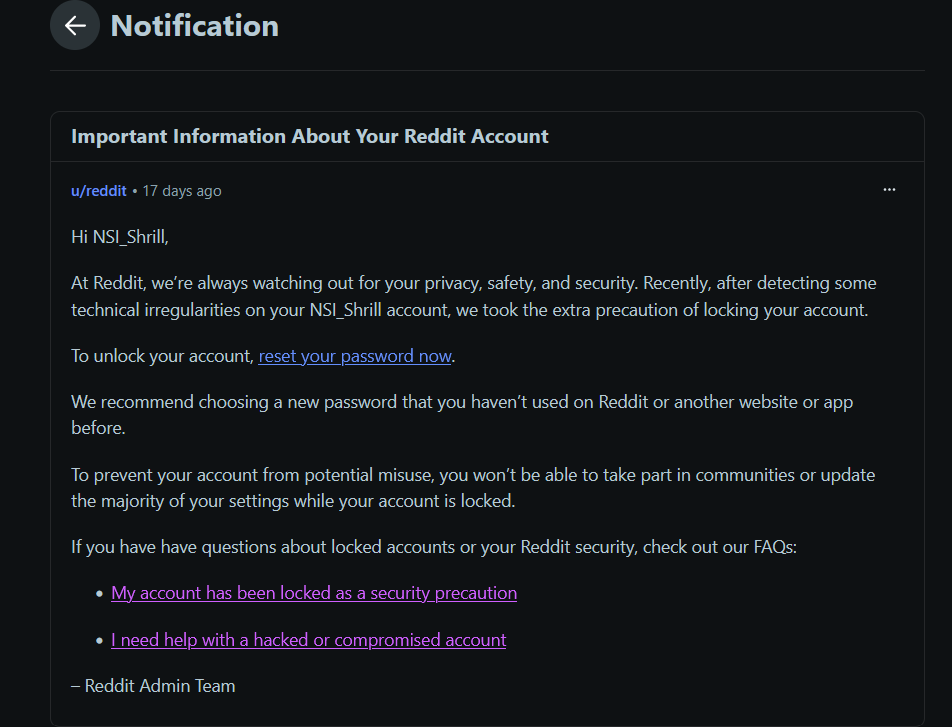
Reddit's bans are particularly deceptive, and their approach to engagement is nonexistent. We received a notification prompting us to reset our Reddit password [7]. We did so and continued using the platform as normal. Over time, we noticed that none of our posts or comments were receiving views, upvotes, downvotes, or any engagement whatsoever. Occasionally, we encountered error messages like [8]. We were investing time in the platform, but nothing we published appeared to have any effect.
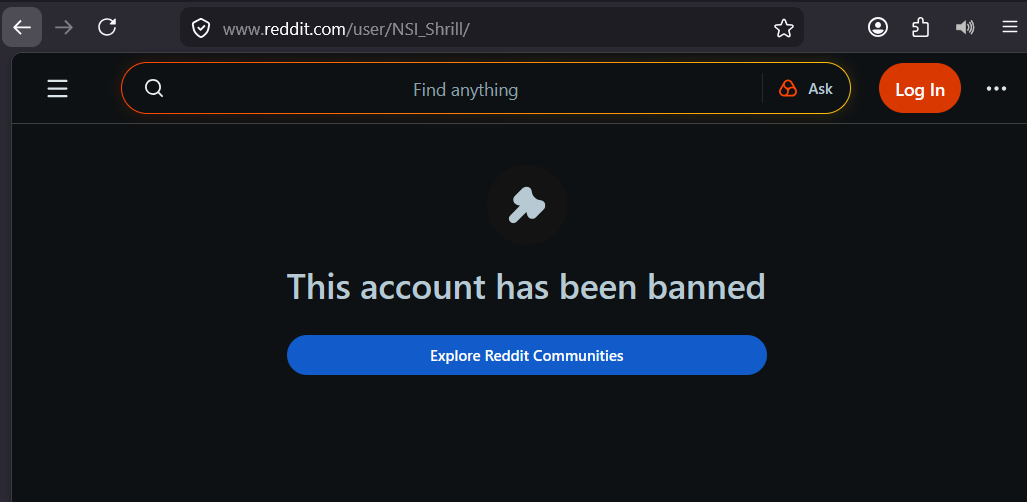
We then checked how our comments appeared while signed out as Reddit does not require authentication to browse. The result showed our account was banned [9]. We had received no email, no in-platform notification while logged in, and Reddit had actively simulated a functioning account. We could (and still can) publish posts and comments they just simply did not exist for anyone else.
The only logical conclusion we can draw is that Reddit's goal is to keep shadowbanned users engaged and inactive. Thus the goal would be to waste users time on the platform rather than appealing, going public, sending formal legal correspondence, or creating a second account. It is a strategy built on deception and costs real users real time, real traffic, and real opportunity.
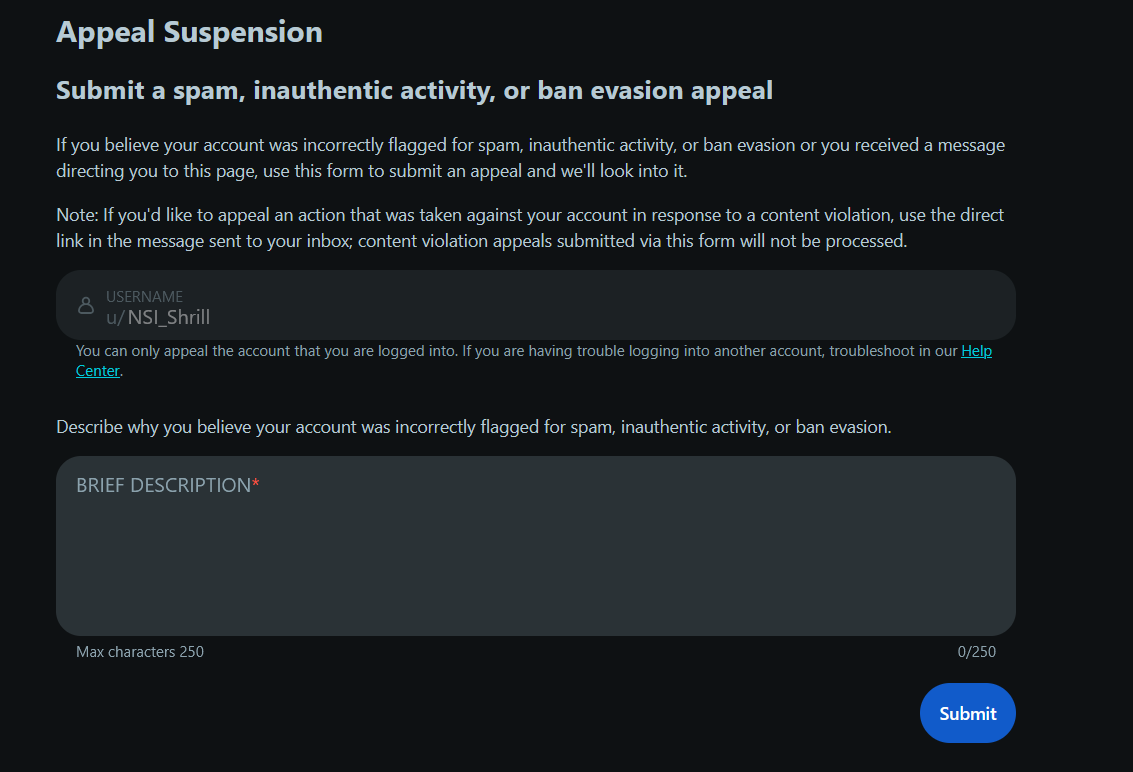
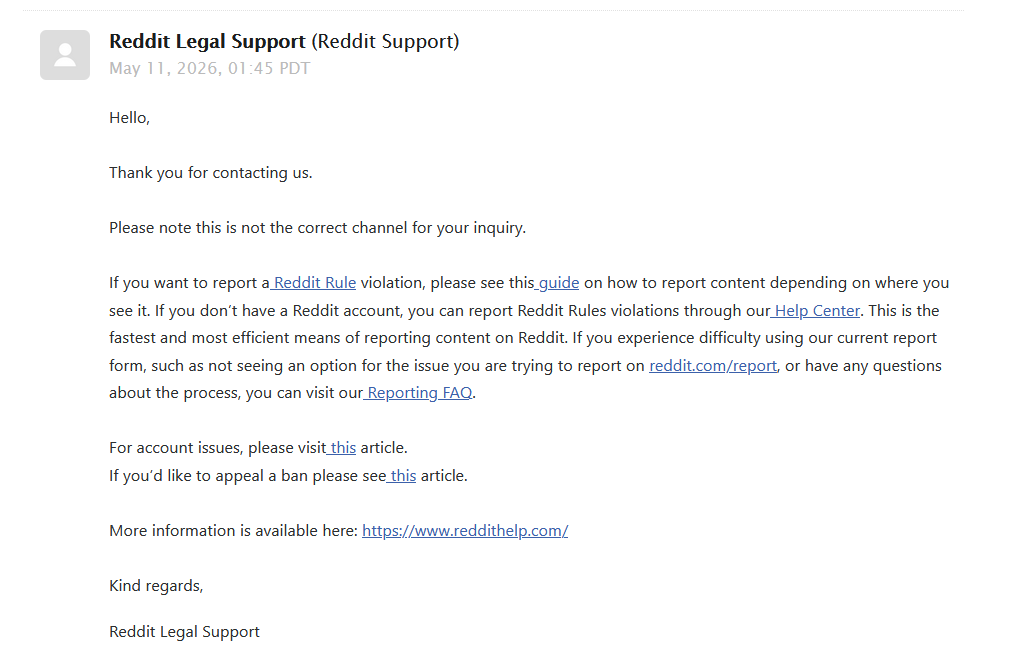
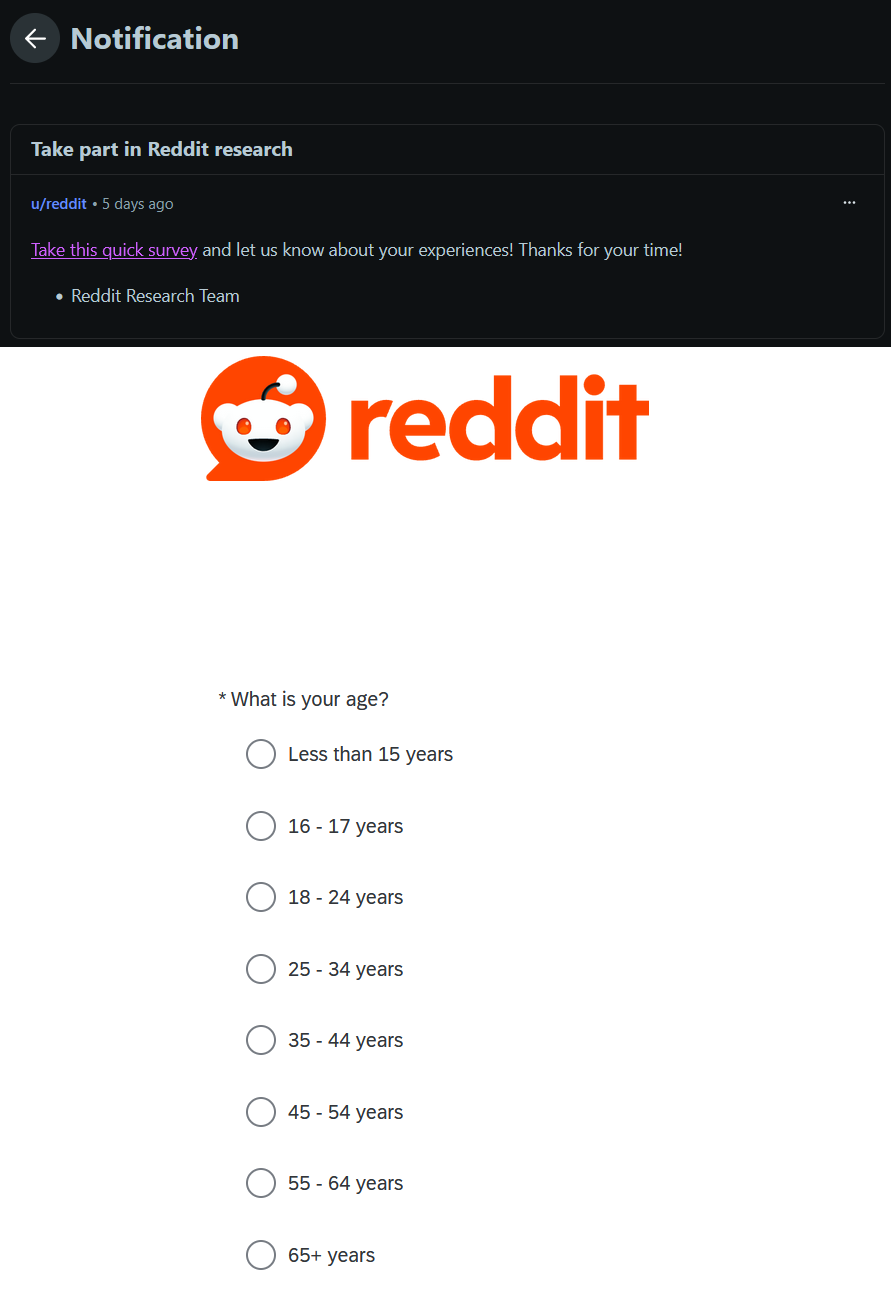
We submitted multiple appeals. Reddit's appeal system permits only 250 characters and no file attachments [10]. This makes any substantive appeal effectively impossible. We additionally attempted submitting our appeal as an investigation report, which allowed file attachments. No official response. We located Reddit's legal contact at [email protected], sent a detailed appeal with supporting documentation, and received a response [11] which was just a canned reply directing us back to the appeal channels we had already exhausted. After trying to submit our appeal via the investigation report and legal email we were asked to take a survey which required us to give our age before proceeding[12].
Before the ban, we had noticed that some of our posts and comments were receiving engagement while others were not. Checking those posts and comments while signed out revealed they were not visible but other of our comments and posts were visible. Again, Reddit did not inform us if they removed a post/comment or not, they pretended that the post/comment was sent but actually made it invisible to everyone else. There was no removed by moderators or removed by Reddit messages just pure deception. The final post before receiving the password reset email (and resulting shadowban) was a comment to a user explaining our experience of the differences between Kimi and Qwen for coding agents. We do not know whether that was the trigger for shadowbanning our account or not.
What we find particularly troubling is that after banning our account without informing us of the ban Reddit continued to send us advertising solicitations to our email (and continues to do to) from "Reddit for Buisness <[email protected]>". A company that silently bans users and then still advertises with the intention of gaining money cannot be trusted. If we did actually pay Reddit money would our paid advertisements have been shadowbanned too?
Reddit was the platform most harmful to us in terms of concrete impact. It generated the most organic traffic to our website. But beyond the commercial value, we genuinely enjoyed contributing. We followed Reddit's own posted guidelines maintaining roughly 90% non-promotional engagement, with approximately 10% promotional content and many of those contributions generated meaningful, substantive discussions under the section Feel free to post links to your own content.
This was also not our first Reddit ban. When we created the account more than a year ago, our very first post resulted in a shadowban. We submitted multiple appeals and received no response. We eventually forgot about the account, and when we logged back in months later we noticed the account had been reinstated without any notification from Reddit. That first ban taught us the unspoken rules: comment first, like first, build slowly, behave the way the algorithm defines "ordinary." Perhaps Reddit will unban us again. Though according to them, we were never banned in the first place.
For a helpful list of hints for Redditors to know if their posts, comments are actually showing to other users and to know if their account is shadow banned see Helpful Hints for Redditors.
How X Banned Us
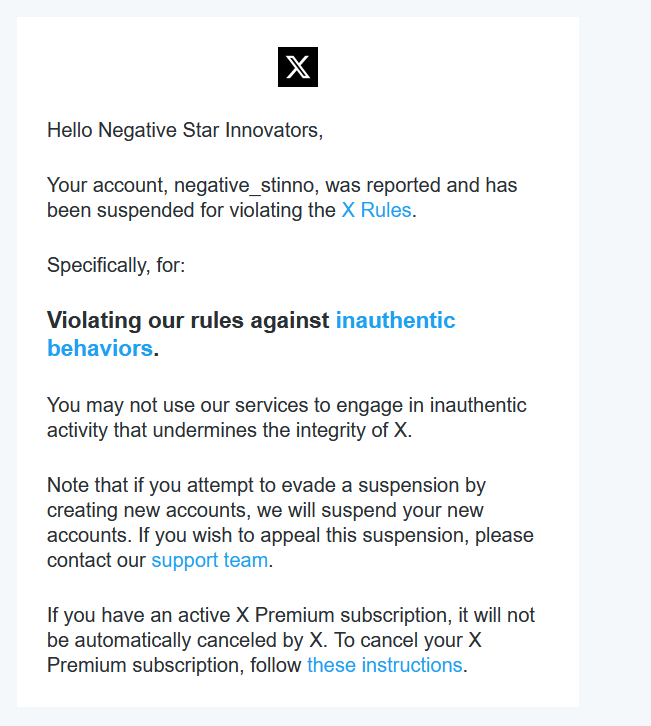
We had maintained an active X account for over a year and held a paid Premium subscription. X sent us an email informing us our account had been suspended [13]. The email stated our account had been "reported" for "violating our rules against inauthentic behaviors" and that we "may not use our services to engage in inauthentic activity that undermines the integrity of X."
The word "reported" may indicate another user(s) report was the initiating trigger. We cannot confirm this with certainty as X used templated language but the implication is that one or more accounts filed reports against us, and X acted on those reports without disclosing how many there were, who filed them, or whether their legitimacy was verified before action was taken against a paying subscriber.
The email also contained this: "If you have an active X Premium subscription, it will not be automatically canceled by X. To cancel your X Premium subscription, follow these instructions." The implication is straightforward: when your account is suspended, your Premium subscription continues running. X does not pause it or refund the remaining period of the subscription. The responsibility to cancel falls entirely on the customer. Every day between the suspension and the cancellation is money X retains for a service they are not providing. This might be defensible if the suspension came with a clear explanation with evidence of the violation, a functional appeal process, and access to the Premium support channel the customer is paying for. None of those things existed. The same email that told us to cancel our own subscription also directed us to contact their support team to appeal. When we attempted to do exactly that through the Premium support messaging section, we received a "failed to send" error. The appeal pathway offered in the suspension email did not function.
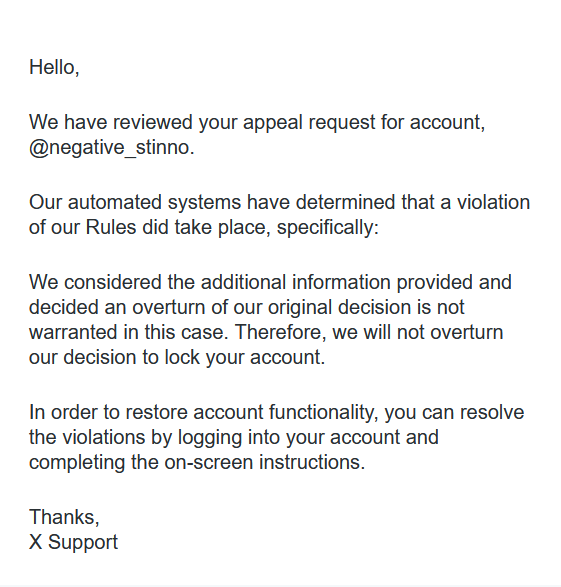
We appealed three times through the available channels. Each time we received the same templated rejection [14] sometimes within minutes, sometimes the following day, a variation in timing that itself suggests inconsistent or absent human review. The rejection stated: "Our automated systems have determined that a violation of our Rules did take place, specifically:" and then named no specific violation. The sentence ends where the reason should begin. The same response instructed us to "resolve the violations by logging into your account and completing the on-screen instructions" but when we logged in, there were no on-screen instructions of any kind. The resolution pathway described in the rejection did not exist.
After the third declined appeal, our account appeared to resume functioning without explanation. There was no message indicating the ban had been reversed. The ban notice simply disappeared. We could post, comment, and notably access Premium support again, a channel that had been unavailable during the suspension. Whether this was a deliberate reinstatement or a system anomaly, X did not say. What followed made the distinction largely irrelevant.
The Shadowban
Our account was functional in appearance only. None of our replies appeared on any posts we commented on. This was not occasional. It was consistent, across every comment, on every post, without exception. We were receiving view counts on our comments the number was incrementing but the comments themselves did not appear in the posts' comment sections. Not under the main replies. Nor even under "show probable spam." Not anywhere visible to another user.
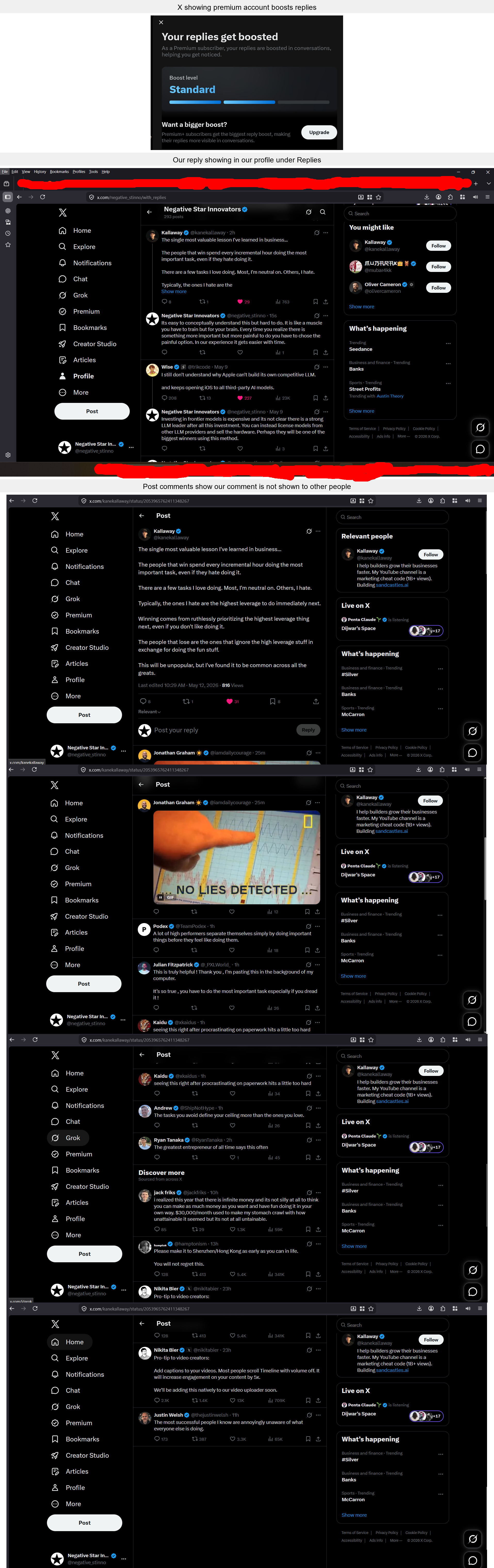
We hold a Premium subscription. One of the benefits we pay for is "Boosted Replies", which X markets as follows: "As a Premium subscriber, your replies are boosted in conversations, helping you get noticed" If zero of our replies are visible to anyone, the boosted replies feature is delivering zero of its stated value. We are paying for a feature that the same platform's systems have silently disabled.
The evidence is documented in the screenshots below[15]. The first section shows X's own Premium interface advertising the reply boost. The second section shows our profile's Replies tab our comments are listed there, visible to us, appearing posted. The third section shows the actual posts we replied to. Our comments do not appear. There is no removed notice. No spam label. No trace. From any other user's perspective, we never replied at all. It didn't just happen to this comment but every single comment we make.
Our posts presented a similar problem. When searched on X from our own account or from another person's account our recent posts returned zero results. Other users' posts from the same time period were searchable. Ours were not. Our profile is accessible and the posts show in our profile but our content was invisible to the platform's own search index which indicates that they are also not shown to anyone else as well unless they manually clicked on our profile.
What X's Support Told Us
When Premium support became accessible again after the ban appeared to lift, we contacted them [16]. The initial response came from Grok X's own AI which repeatedly directed us to the appeals page regardless of what we said. We stated clearly that our account showed as not suspended, that our comments were not appearing on posts, and that we needed to speak to a human. Grok responded by asking us to clarify whether we were referring to "this account or a different one" and then directed us to the appeals page again. When we asked Grok to confirm the status of our account directly, it responded: "I'm unable to confirm the exact status directly." X's Premium AI support could not tell a Premium subscriber whether their own account was banned.
After explicitly requesting human escalation, we were assigned a reference number and told a specialist would contact us.
The human response came from a support representative. Her reply: "There are no changes to be made to your account to improve visibility or reach. Just post what you are up to/building/working on/love to do. Be yourself. Others will find you. That's what the algorithm is for!"
This response is utterly useless to what we were reporting. We had not asked how to improve our reach. We had reported a technical fault: a paid feature Boosted Replies was non-functional because our replies were invisible to the platform. We responded accordingly:
"Thank you for the link, but my issue is not related to the algorithm, engagement, or reach. I am writing to report a technical bug that is breaking my paid Premium features. As a Premium subscriber, I pay for the 'Boosted Replies' feature. However, due to a backend error, my replies are entirely invisible on the platform. I have attached two screenshots proving this is a system error, not a visibility issue: 1. A screenshot of my Profile's 'Replies' tab, showing a comment I successfully posted. 2. A screenshot of the original post I replied to. As you can see, even when I am logged into my own account, my comment does not exist on the post not even under 'show probable spam.' The system is completely ghosting my inputs. Furthermore, my original posts have been entirely removed from the X Search Index. If you search for my recent posts from your end, you will see they yield zero results."
X's final response: "Regardless of subscription status, all replies are still subject to compliance with X Rules. Replies may be marked as spam or unavailable when unrelated to original posts, of low quality, or if X sees behavior that violates our platform manipulation and spam policy. Please focus on creating high quality content that is responsive or does not infringe on these rules."
This response did not address a single point we raised and didn't even mention why our posts were also not searchable in X Search Index. We submitted documentary evidence two screenshots demonstrating that a reply visible on our own profile was entirely absent from the post it was made on. X's support responded by suggesting we create higher quality content thus putting the blame with us.
Analysis
The X situation contains several distinct failures that are worth separating.
The appeal process is structurally non-functional. Three appeals produced three identical responses, each citing a violation it declined to name, each directing us to on-screen instructions that did not exist. Then our account was unsuspended but showdow banned without notification. This is not a flawed appeal system it is the absence of one.
The human support response demonstrated either an absence of reading comprehension or a deliberate policy of non-engagement. We submitted visual evidence of a technical fault. The response was a content quality lecture.
Either X support staff was instructed to respond in this way regardless or incompetency. Both possibilities are damaging. It suggests a policy of wearing down subscribers who raise inconvenient issues until they give up.
X is collecting Premium subscription fees from an account whose Premium features do not function. This is not a grey area. The Boosted Replies feature is a stated deliverable of the Premium subscription. The screenshots demonstrate it is not being delivered. Whether this constitutes a breach of contract is a legal question but as a matter of plain fact, X is being paid for something it is not providing, and its support team's response to documented evidence of this was to tell us to post better content.
The shadowban structure itself is the most significant issue. An account that appears functional that can post, comment, and receive view counts but whose content is invisible to every other user is for intents and purposes a suspended account. Shadowbanning is a policy of managed invisibility designed to prevent the user from understanding what has happened to them, and therefore from responding to it. We are paying for an account in that condition. X knows this. Their support team confirmed it, obliquely, by declining to deny it and redirecting us to content quality guidelines instead. Even if quality were the issue, being informed of which specific posts and comments fell short would allow the user to understand and correct their behaviour. That explanation does not hold here regardless as every comment and every post faces the same invisible treatment, without exception. That is not a quality filter. That is a blanket suppression, a shadow ban.
How LinkedIn Banned Us
Our LinkedIn account was approximately 11 months old. Please note that without access to the account, some figures may be approximate. Over the preceding 3 weeks, we had sent fewer than 15 connection requests, some personalized messages perhaps 10 in total. We had published approximately three articles, roughly one per week, and commented on other people's posts around 10 times. We had made one connection during this period. Our activity was neither exceptional nor excessive and was all human generated.
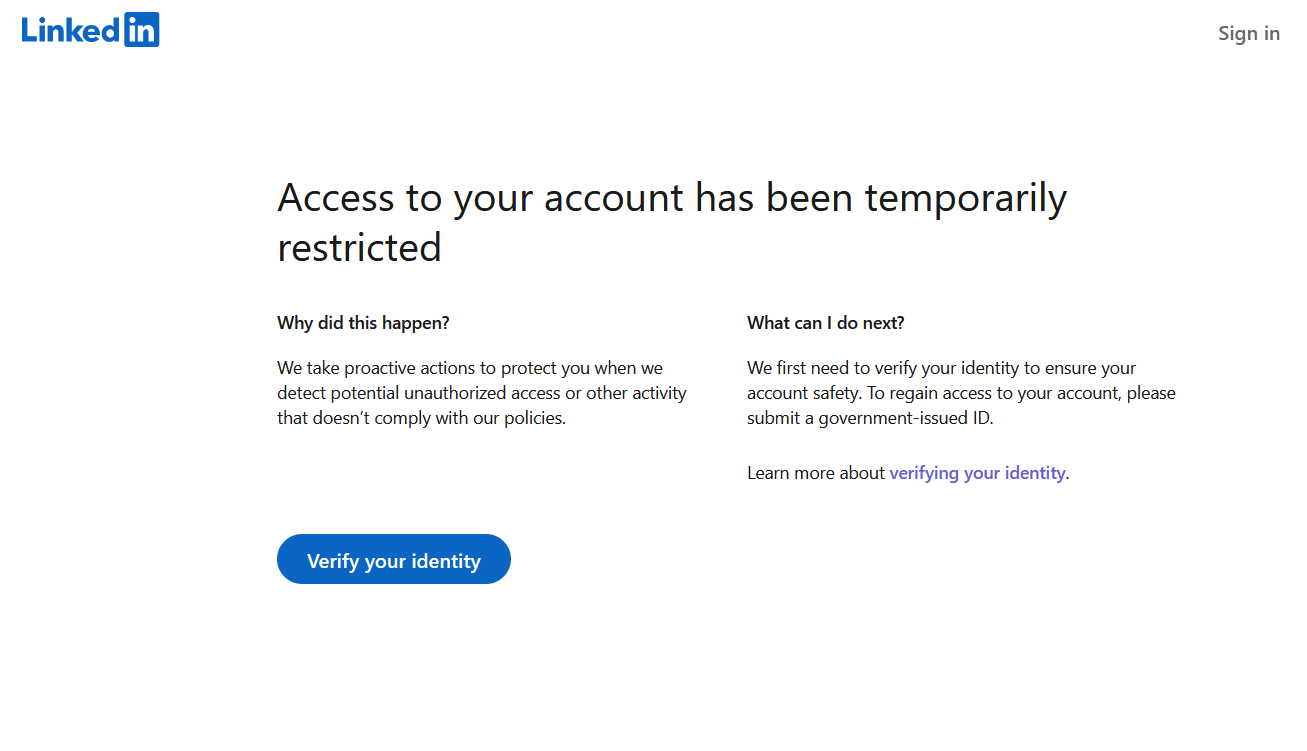
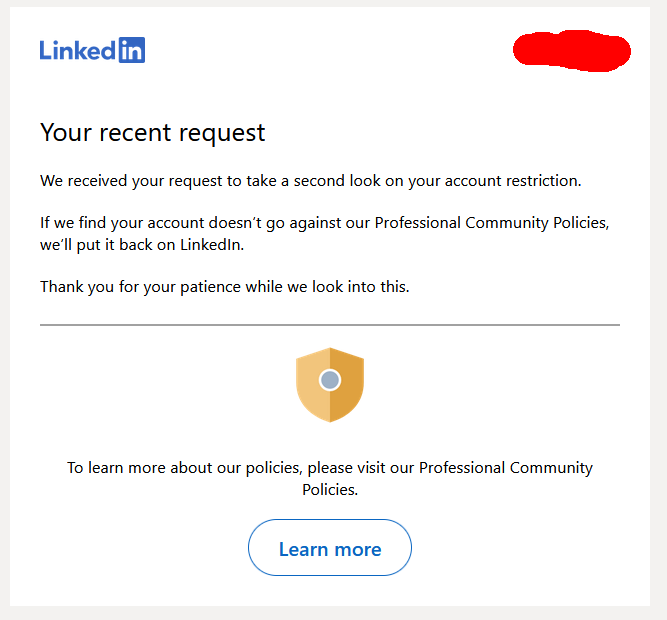
We had not used LinkedIn for a day, though we remained logged in. LinkedIn then logged us out which was unusual behavior to us. When we attempted to log in, our password did not work. We initiated a password reset. LinkedIn then stated that it needed to verify our identity before proceeding. The message was not alarming in tone [17] "Access to your account has been temporarily restricted. Why did this happen? We take proactive actions to protect you when we detect potential unauthorized access or other activity that doesn't comply with our policies. What can I do next? We first need to verify your identity to ensure your account safety. To regain access to your account, please submit a government-issued ID" Really harmless in tone, they need to identify us and all is good. In fact they guaranteed we would get access by stating "To regain access … submit a government-issued ID". There is no qualifier in that sentence. No 'may.' No 'subject to review.' Submit the ID, regain access. That is what it says. What followed made clear that was not what they meant. So based on Linkedin's personal guarantee we completed the verification and received this via the onscreen verification confirmation[18] and subsequent email "We received your request to take a second look at your account restriction. If we find your account doesn't go against our Professional Community Policies, we'll put it back on LinkedIn. Thank you for your patience while we look into this". That was a significant change in tone. It became alarming because of what it revealed about the situation we were actually in. We believed we were resolving a routine login issue. We had submitted our government ID without being told we were under a policy review. Had we known the account was subject to a potential permanent restriction, we would have evaluated whether to submit such sensitive documentation far more carefully.
If LinkedIn's intent was to use our identity verification as a means of ensuring we could not use the platform again rather than as a genuine pathway to reinstatement then obtaining that ID under the framing of a routine check constitutes a form of deception. We had no written statement of the alleged violation. We had no opportunity to submit evidence in our defense. We were not told we were being accused of anything.
We ask anyone reading this to consider the following: if someone intended to accuse you of a serious offense and may have already decided the outcome, would you voluntarily hand over government-issued identification and biometric data before knowing you were a suspect? The deliberately low-stakes framing of these verification requests exists precisely to prevent users from making that considered choice. We were not given the opportunity.
The implications of a LinkedIn ban are potentially severe. There are job roles for which LinkedIn is effectively a prerequisite for application via only advertising on Linkedin. Many companies treat the absence of a LinkedIn profile as a signal of untrustworthiness. Many online platforms and even non job applications(such as VCs application forms) require a LinkedIn profile as a condition of participation. While the fault partly lies with organizations that have made LinkedIn compulsory rather than with LinkedIn itself, the practical reality is that LinkedIn has become the de facto professional identity layer for much of the working world. A permanent ban carries real-world consequences in employment, credibility, access and opportunity. Consequences that fall entirely outside any legal framework, and that LinkedIn is not required to explain or justify to the individual affected.
That absence of accountability is precisely what makes it an ethical failure, regardless of whether it is a legal one. Even if LinkedIn has the full legal right to ban users for any reason, it has an ethical responsibility to explain why, and to allow the person a genuine opportunity to respond. People's economic opportunities and thus people's actual lives and well being are at stake here.
The Practice of Collecting Identity Under False Pretences
Both Threads and LinkedIn requested identity documents in a manner designed to appear routine and non-threatening. In both cases, the platform had already made or was in the process of making a decision to restrict or remove the account. In both cases, users were not informed of this when the request was made.
This pattern is a deliberate design choice. If the intent is to ban the account regardless, then the purpose of collecting a photo or government ID is not verification it is identification. Marking a person so they cannot return. Threads is a Meta product; LinkedIn is part of Microsoft. The potential downstream uses of biometric and identity data collected under these conditions extend well beyond the platforms themselves. LinkedIn used a third-party service called Persona for biometric processing. What happens to that data? Who else has access to it?
We still awaiting Linkedin's decision but the case of Threads is clear. The identification was not the reason for the ban. They banned us based on our account information thus they could have done a check of our account data and banned us without ever asking for our biometric data.
We raise this not as speculation, but as a structural concern. If a platform intends to permanently restrict your access and is simultaneously collecting unique biometric or identity data from you, you have a right to know that these two things are connected before you consent. We were not given that right.
How Social Media Shapes Our Behaviour
We had not been social media users until approximately one year ago, which gives us an unusually clear view of how these platforms operate on new users. Every ban, every near-miss, every warning has taught us to modify our behaviour: follow fewer people per day before gradually increasing; avoid topics that are distressing or contentious; do not be too much of ourselves. We are, in effect, being trained.
The concern is not just what we personally have lost. It is what everyone who uses these platforms is being shaped into over time, at scale, often without awareness.
What Are The Odds?
We are not conspiracy theorists. But when institutions refuse to explain their decisions, they do not prevent speculation. They remove the only tool that could distinguish reasonable speculation from unreasonable speculation. Everything becomes equally possible. That is the cost of opacity, and it is a cost these platforms have chosen to impose on us.
So let us look at what actually happened.
Within 21 days, four separate platforms each with independent moderation systems, each making independent decisions arrived at the same outcome against the same account. These were not accounts that was new, dormant, or anonymous. They all had over a year of history (apart from Linkedin which was around 11 months old). They were growing. It was generating genuine engagement and organic traffic. It was following each platform's stated guidelines. It had real followers who were real people, responding to real content.
Consider what would need to be true for this to be coincidence. Every moderation system produces false positives we will address this directly in a moment, using Meta's own words. But the probability of any individual account receiving a false positive ban is low. The probability of the same account receiving four simultaneous false positives across four independent systems, within 21 days, while operating within stated guidelines and actively growing, is a different order of magnitude entirely. We are not claiming certainty. We are claiming that coincidence is the explanation that requires the most work to defend.
And yet we cannot explain it. We do not know what triggered these bans. We do not know if the cause was the same across platforms or different. We do not know if user reports were involved, and if so how many, from whom, and whether their legitimacy was verified before action was taken. We know none of this not because the information does not exist, but because the platforms have chosen not to share it.
That choice has a consequence that the platforms may not have fully considered. In the absence of any explanation, we cannot rank possible causes by probability. We cannot rule anything out. The mundane explanations such as simultaneous automated false positives, a domain reputation flag that cascaded across systems, a handful of organic user reports that coincidentally clustered remain possible. But so does something more deliberate and coordinated. Someone who wanted to remove a specific account from multiple platforms simultaneously would find it straightforward to file reports across all of them. The cost is near zero. The platforms would each act independently, each unaware of the others, each believing they were responding to organic signals. No coordination between platforms would be required. No trail would be left.
It is possible this happened and nothing the platforms have told us which is nothing allows us to rule it out.
We will say this much about motive. We work in the privacy space. We have built a product that keeps personal information on your own device rather than sharing it with third parties. Even we cannot see your personal data. We been public with our ambitions to extend the scope to protecting people's data from AI agents. The logic of what we are building is a direct challenge to a data collection model that a number of large organizations depends on. Whether that connection is relevant to what happened, we genuinely do not know. We raise it only because the platforms' silence makes it impossible to know.
False positives in automated moderation are not a conspiracy theory they are an acknowledged reality at the highest level. In January 2025, Mark Zuckerberg stated publicly: "We built a lot of complex systems to moderate content, but the problem with complex systems is they make mistakes. Even if they accidentally censor just 1% of posts, that's millions of people, and we've reached a point where it's just too many mistakes and too much censorship." He added: "It means that we're going to catch less bad stuff, but we'll also reduce the number of innocent people's posts and accounts that we accidentally take down."
We accept this that automated systems at this scale will produce false positives. We are not arguing our bans were impossible. We are arguing two things.
First: four simultaneous false positives, given everything described above, is not well explained by routine error rates. Second: when a false positive occurs when a real person with a real account and a year of activity is permanently banned by an automated decision there must be a genuine path to demonstrate that. Not a selfie or government issued ID obtained under a false pretext. Not a 250-character appeal box with no file attachments. Not a support response that ignores documented evidence and suggests you post better content. A real process, conducted in good faith, with a real human being capable of making a real decision.
The platforms could resolve every uncomfortable question in this section immediately. Tell us what triggered the bans. What specific posts or comments. What reports, if any, were filed. What threshold was crossed. They do not need to identify any individual complainant. They need only to explain what actually happened.
Their continued silence is not neutral. It is an active choice and it is a choice that leaves every explanation, including the most serious ones, equally open.
We are publishing this as a formal record and as a direct challenge. If the explanation is mundane, prove it. We would genuinely welcome that answer. Until then, we cannot pretend the question is closed.
What Can We Do?
We used to believe that if we were banned from one or two platforms, others would remain available. Markets are competitive; if one option fails you, you find another. Our personal experience is showing that reasoning is becoming harder to sustain. The cumulative weight of these bans feels like something other than coincidence, even if it is not.
We do not currently have the resources financial or legal to pursue action against four massive platforms (companies) simultaneously, and based on recent history we likely will have more bans in the future by different companies to fight. We are not large enough for this story to generate the kind of public response that forces accountability. We are aware that publishing this may result in further bans on the platforms we still have access to. We are publishing it anyway. The behaviour we have experienced has made one thing clear: if you do not own the platform, you are at the mercy of whoever does. We own this blog and will write our views freely here.
Even if very few people read this post, that is fine some things are worth documenting and sharing regardless. History shows that meaningful change rarely comes from a single decisive moment. It comes from accumulation. Early attempts fail. Then more attempts fail. Then one doesn't, and everything shifts. We do not know if this post will matter. We suspect it won't. Not directly, not immediately. But it is one more attempt in a sequence that eventually produces an outcome. Every attempt at change has a non zero chance of succeeding. Let the implications of that fact reveal itself.
When everything is stacked up against you in any situation the only chance to succeed in your goal whatever that may be is to take bold action. Playing by the rules will guarantee you no victory. Only with bold actions you have a chance to succeed. That chance may be low but its not zero.
If you have experienced something similar on these platforms or others share it, wherever you still have access to do so. Write it down, make a video. Make it public. Share this article too. You can also reach us through this blog and we may compile further accounts in a follow-up post. None of us may individually succeed in changing anything. But collectively, and over time, one of these attempts will succeed.


References and Evidence


Helpful Hints for Redditors
- Your posts and comments may not show to other people and Reddit may not inform you. Check the posts and comments while you are signed out to confirm.
- If you not getting any engagement check if your account is banned. Reddit may not tell you so you need to enter "https://www.reddit.com/user/[USERNAME]/" while logged out, where [USERNAME] is your Reddit's username. If it states the account is banned then you have been banned. Another way of checking is just to enter "https://www.reddit.com/appeals" while logged in. If the submission option is not greyed out you are banned.
- Thus far Reddit does not inform you if your ban is lifted or not. Thus, check regularly on your profile in case your account has been unbanned.